Friday Firesmith – Normal

When I read Tara Westover’s memoir, “Educated,” she brought up a point most people wouldn’t get because they never thought about it. I missed it. And once Westover pointed the obvious out, it seemed like a neon sign, but that’s the nature of people, especially those who are raised in small towns. Normal is what you grow up with and see every day. That doesn’t mean it’s normal outside that context. In fact, it might not be anywhere near normal.

Westover’s father was a lunatic on the order of magnitude. More than once he told his family not to use seatbelts while he was driving, and drove through blizzards at sixty miles an hour because God was looking out after him and his family. God wasn’t. Mr. Westover wrecked his van more than once, injuring his wife and children. He barely survived an accident involving a gasoline explosion, and so did his oldest son. But to Tara Westover, who grew up in this environment, isolated from the rest of the world, this was normal.

I awoke a couple of hours ago, about two in the morning, and couldn’t remember the name of the pizza place in my hometown.

Pizza Hut experimented with have a franchise in Blakely Georgia, but it closed sooner than later. Blakely is one of those towns that is on the brink of becoming bigger and always will be. It keeps spreading away from the center of town, as most small towns do, but it’s like a condiment on a butter knife trying to cover an entire bun. There’s only so much.

People in small towns yearn for change as long as everything stays the same. No one ages, no one dies and no one is unhappy, until someone old dies, unhappily. But replacements are a dime a dozen, and the process begins anew with each death, only the names change.

But I can’t remember the name of the original pizza place.

So on occasion, my father would send me to go get pizza. He could give me money and I would walk the mile or so to the pizza place, whose name is gone forever now. I never stopped to think it was odd he sent me out on foot to get food, but it was never warm when I got back. No sidewalks or anything like that, and I wonder if people saw me walking with a pizza. We could have called it in, a minute or so both ways in a car, and then the pizza would still be hot. Of course, I ate it anyway because it never occurred to me things could be different.

The house that belongs to my father was always his house. I was a tenant, off and on, until I bought my first house, yet the house I bought was my first home, the first place I ever felt like I belonged. My father’s house was a prison when I was in school, and later, it was a symbol of my failure to launch, but never home. Never.

I’ve lived in the house in the woods now for nearly twenty-five years. Six dogs and a cat found their final resting place here. The nearest pizza place is eight miles away. The memories of my hometown pale a bit more every year, and Google Maps show me an alien and unwelcoming town where I was a stranger when I lived there, and I always will be.

Take Care,

Mike
Friday Firesmith – Home for Christmas

Back when I was in the Army I ran into men who had never left their hometown before. I found that odd, but then again, there I was in Fort Stewart Georgia and I was from Georgia. But a guy we called Buddy, his last name was Eastern European and had about a gazillion letters in it. We called him Buddy. It was a lot simpler.

Buddy lived in the north part of Minnesota, grew up on a farm, was a large man but seemed to shrink sometimes, when he was sitting around with us, playing Risk and drinking. He would sit on the floor, his back to the wall, and he seemed to almost disappear in his silence.

Christmas rolled around, his first Christmas in uniform, and he couldn’t get a flight into anywhere close to where he lived. The whiteout conditions sealed him out of his home state, and away from his family. Buddy started drinking early in the morning on a Monday, Christmas Eve day, and most of the guys who were going home were already gone. I was leaving Christmas day, and could leave early and be there by lunch. I asked Buddy to come with me and he shook his head.

            “That would make it worse, I think,” he said, and fell deeper into silence. We drank, played Risk, and the guys who had been in for years had gotten used to the routine of not going home, and some of them didn’t want to for one reason, or a lot of reasons.

            Buddy was a quiet man who read frequently, drank on an  irregular basis, and by and large seemed neither happy nor unhappy about being in the military. When he called home from the payphone in front of the barracks he would spend an hour or so talking to his folks, or his sister, or grandparents, and this made him happy. His father sent him a photo of a new tractor and he passed the picture around like it was the first photo of a new baby.

            As the night grew thinner, most of the guys wandered off, and the winner of the game, it wasn’t me, I remember that much, declared himself ruler of the known world, but somehow Buddy had disappeared.

            I went back to my hometown, stayed a day or so, then returned. Buddy and I had breakfast together and he seemed more alive. Buddy had met a woman. Instead of going to his room and passing out, Buddy had left Christmas Eve and started walking. He walked all the way to the edge of the base, and then he kept going, until he hit an all night restaurant. He got something to eat and the waitress sat down at the table with him and they talked for the rest of the night. She had married a guy in service, divorced him because of drinking, and wound up sticking around Fort Stewart. Buddy walked to the restaurant two or threes times a week, and finally, she picked him up after work one day, and took Buddy home with her.

            They got married after I left service, and I found out when I dropped in for a visit six months after I got out. Buddy was with his woman and he rarely hung out with the guys anymore. He still had three years left on his contract, but he had shown the guys a photo from his father, where they were building a house near the one where Buddy grew up. However many Christmas days he missed being in uniform, he had found love in an odd way, and in the end, Buddy was home for Christmas not because of where he was, but who he was with.

Take Care,

Mike

Friday Firesmith – a “BAH HUMBUG!!!”

A week before Christmas and I rather chew glass soaked in rubbing alcohol than hear one more Christmas song. This close to zero hour and shoppers have become predatory and feral. Going into any grocery store at this point requires a spotter with a scope, air strikes on call, and body armor. I’m thinking of taking a shopping cart and going full on Mad Max and putting spinning razors on the front with a flame thrower.

It’s beginning to look a lot like Christmas.

I’ve always hated Christmas. Even as a little kid I knew there was no Santa Claus. I also knew Christmas was a time America, as a culture, reaffirmed the idea that poor people were somehow to blame for their lot in life.

Santa brings toys to good little girls and boys.

Poor children don’t get as much, or anything at Christmas.

Ergo, poor children are bad.

American Christmas is a competition to see how much your kids mean to you, and most people aren’t even aware this is happening. Yet ask kids what they do the day after Christmas and they’ll tell you they’re comparing what they got versus what other kids hauled in. Worse, the overabundance of gifts makes for overstimulation, which leads to a let down when the buzz dies. By New Year’s, the people buying presents are ready to go on a bender. The people who got the presents feel oddly hollow.

In the meantime, every scrap of wrapping paper, all the plastic packaging, all the Christmas trees that haven’t already burned a house down, and all the food no one ate will be thrown away. The trashcans lining the road will be filled to overflowing. All of those trashcans all across America are a symbol of waste, not wealth. They are a symbol of bribery, not love. They are a sign of a civilization based on consumption, not care.

Retail stores can count on between 20 to 25% of their yearly sales to come from Christmas. With all the waste, I wonder what would happen if we simply stopped buying Christmas presents? Would we discover we do not need so many shopping malls and giant stores? Would we have more room in our homes? Would we spend time with our families instead of buying them off once a year?

What if after Thanksgiving, we put a 20% sales tax on gifts just to calm people the f*ck down and stop the madness?

Sunday, I’ll build a fire to coax the sun into returning to warm the Earth again. That’s all the celebrating I will do. I might have a friend or two over, and we’ll sit and stare at the coals, and talk about the things we remember.

On the 25th, we will feel a bit sad that Christmas isn’t what it once was, but it never was, and in some odd way, we know it. It will be a week or maybe longer before the trash is picked up, and in the end, the mountain of trash will be the most permanent reminded of Christmas 2025.

Take Care,

Mike

Friday Firesmith – Dry

Stephen King says he doesn’t remember writing “Cujo.” It’s a forgettable tale, with the antagonist being a Saint Bernard dog who is bitten by a bat that has rabies. Animals with rabies aren’t usually active enough to trap people in cars and that sort of thing, and the movie was worse than the book.

King freely admits he was drunk most of the time he wrote “Cujo.”

Writers and alcohol. I swear.

Once upon a time, I had enough alcohol in my system to be legally dead. But the Army bred substance abuse and sometimes I wonder if it was intentional.

I was down to a six pack a week, but I was drinking 9.5% IPAs. And I would drink the six pack all in one day, usually in a few hours. The next day I would check social media and my phone to make certain I didn’t day or write anything that would piss anyone off. I never did, of course, but the thing that bothered me is I did write things I didn’t remember sometimes.

None of this had anything to do with a rabid Saint Bernard.

The day after my birthday, I took an empty six pack to the trash can, tossed it in, and stopped drinking. That was the 10th of November. The 10th of December made an entire month.

I started drinking at age 13. By high school I had a serious problem. I would pass out in class or out in the grassy area where we ate lunch, or in my car. The 1970s were a time where hard drinking was a rite of passage, and even though many teachers thought my liquid state was a terrible thing, no one said anything to me about it. Ever.

Part of the reason was they were afraid to fail me out of a grade in school because that meant I would return the next year. I think their plan was to just get me to graduation, and then I would no longer be their problem. The Army put up with drinking by sending soldiers to AA. AA kicked me out because I steadfastly refused to admit I had a problem.

I evolved from drinking every day to drinking only once a week, over the course of the years. But I was still getting so hammered I couldn’t write and sometimes forgot what I had done the night before.

I’ve flirted with this for a while. There isn’t a real reason to drink except I always have, and for most of my life, hard drinking was a sign of manhood and strength.

The younger crowd has it right again. Those people born after Y2K do not feel compelled to pick up a self-destructive habit.

And it’s time for me to step away from a habit that has never really proved anything to anyone, except I am a product of my culture. I’ve never felt like I was that kind of person. Now, finally, maybe, I am not.

Take Care,

Mike

friday firesmith – interesting stories

“I ain’t got that,” the woman says, loud enough for me to hear her from where I’m standing. She’s likely my age, looks like she’s lived hard and there’s no mirth about her body language or her words. The cashier at the store has been around for a while and has heard it all before.

“Do you want to put some of the items back?” the cashier asks mildly.

“I got what I got and I ain’t got that much money,” the woman is speaking louder now. She looks at me. I look back.

“Ma’am, would you like us to restock this?” the cashier says sweetly.

“I need this. I ain’t leaving. You got to give it to me,” she demands, and now she’s trying to get the bagged groceries back in her cart.

“Ma’am, if you cannot pay we’ll have to take something off or restock,” the cashier is like oil on ice. She’s cool and slick.

“Gimme ten dollars,” the woman advances on me with her palm out. Behind her, the cashier is taking a few items out and taking them off the total.

“Tell me something interesting,” I reply, vamping for the cashier, who grins at me.

“What?” the woman snarls. “I ain’t got to tell you nothing.” She’s getting animated now, talking louder and looking around for help. There’s a reason I shop early, and that reason is to avoid people. It’s failed this time, certainly.

And this makes me wonder. The woman isn’t going to get much help with her con at this time of the morning. Paralyzing the only open line is a great idea if you want someone to buy your stuff for you or give you money, but this early there’s no pressure to get her out of the store in a hurry.

She either isn’t smart or she’s nuts. Maybe both.

“You ain’t got no ten dollars?” she demands of me.

“Didn’t say I did or didn’t. But tell me something interesting first,” I reply and I’ve gotten some incredible stories. A woman yelled at me to let her and her husband into traffic and I yelled back, “Tell me something interesting.”

“What?”

“Where did you meet your husband?” I asked. She was with a guy, I just made a stab they were married.

“At a car wreck. We both stopped to help.” The woman is hanging out of the window but the light changes. I wave them on and wave goodbye.

See! I tell you, ask for interesting stories.

The woman in the store wheels around and realizes the cashier has not only taken items out but put the taken items in a bag for the guy who stocks shelves to put them back. He arrives and leaves while the woman rants about starvation.

She pays up then pushes her cart towards the door fussing and cussing, but doing no harm and no good.

“She’s always like that,” the cashier tells me before I can ask. “She’s always ten bucks short, never eleven and never nine. She’s not allowed to come in during rush hour.

“Aha!” I say and the cashier laughs.

“She also tries to return open items that she’s eaten half of, and she claims parts were missing,”

“Really?”

“And get this, she’s owns a million dollar house on five hundred acres of land.”

And suddenly, I have my interesting story. And now, you do, too.

Take Care,

Mike

Friday Firesmith – A man named Bay

Private Bay was an eighteen year old from somewhere in Delaware who had basic training in New Jersey, then Advanced Individual training in Maryland, and wound in at Fort Stewart as one of my room dogs.

Bay was terrified.

He signed up for the Army in high school, left for Basic two weeks after graduation, went home for a few days after basic, then spent a couple of months in Maryland. He went home for a long weekend after that, but here at Fort Stewart, Bay was in the Army now. Christmas was nine months away, and Bay knew he couldn’t afford a plane ticket home every time he missed mama’s cooking. For the first time in his life, Private Bay was looking at being away from home for nine months.

“What’s the longest you ever spent away from home, I mean, before the Army?” I asked.

“Three days at Summer Camp, once, I hated it,” Bay replied. He looked younger than eighteen. He could have passed for someone’s brother still in grade school. He was short, light, and scared to death.

“Wanna drink?” I offered him the bottle of vodka and he declined.

“I’ve never drank alcohol.” Bay was looking around the room as if it were a prison cell and he needed the best options for tunneling out.

“Christ a f**king virgin,” my other roommate, Bob said loudly and he left the room to smoke a cigarette outside. Bob napped late in the day so he and Bay had not quite met.

“Bob, Bay, Bay, Bob,” I laughed and so did Bay. But he was scared.

I was twenty-two, Bob was thirty-nine and about to retire from the military. He had stories. Some of them were likely true. But he had also put his face through the windshield of a car while drunk driving and looked a fright.

The usual drinkers arrived, met Bay, traumatized him without mercy, then we walked down to the PX and got Bay drunk for the first time in his life. He was more than a little green around the gills the next morning during PT.

I walked in after work and Bay was sitting on his bunk looking forlorn.

“Dude, you’re a man now. You’re in the Army,” I told Bay.

“Yeah, I know, and I know I have to grow up. I can’t live at home forever. Julie and I are going to get married and…” Bay was sniffing and trying not to cry.

“Julie? You have a girlfriend?” I was shocked. I was even more stunned that Julie looked younger than Bay. But she was a looker. The photo showed her lying on her back on a bed, one hand poised as if about to unbutton her shirt. Bay was clearly no virgin.

“Dammmmnnnn,” I said and Bay looked slightly annoyed.

“She’s, we’re engaged,” Bay said defensively.

“Julie is beautiful,” I nodded.

I went out drinking with the usual suspects, and while I was gone, Bay got into a cab that took him to the bus station, and he went back home. The Army didn’t make a big deal out of it, didn’t have him arrested, but simply processed him out. We never saw Bay again.

We sat around drinking after he was gone and Bob asked me if I ever thought about going AWOL.

“Nope, I always thought they’d send you to jail for it,” I replied.

“Yeahhhhh, they might, depending on how long you’ve been in. But if you got less than six months they’ll cut you loose sometimes,” Bob knew things. Some of them were true.

“You ever think about making a run for it, I mean when you first got in,” I asked, eyeing the bottle. Bob was bad about hanging on to the vodka.

“Nope.” Bob surrendered the alcohol.

“I wonder why the hell some guys just can’t cut the apron strings,” I said.

“Maybe they wonder why it’s so easy for us to do it,” Bob reached for the bottle and the metaphor formed even as Bob spoke, “Some people have family, some people have habits.”

Take Care,

Mike

Friday Firesmith – Under the crescent moon

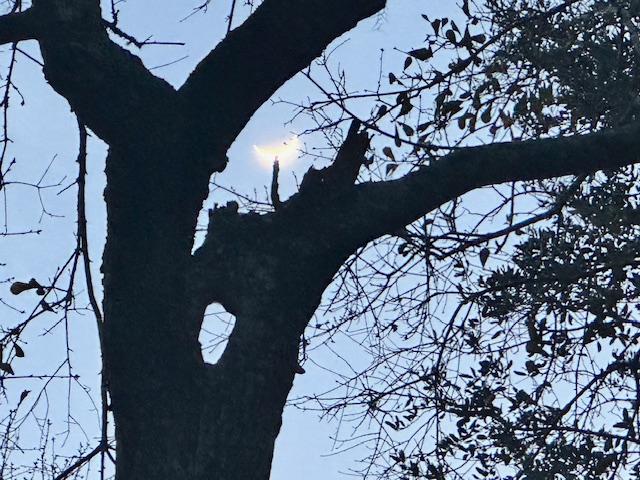
The sun is still asleep, and the Crescent arises in the east, southlands of the skies, and yellowish in hue. The air is cool, down in the fifties where last week at this point it was below freezing. This is fall in the middle of November, south of the Gnat Line, three miles north of Florida, in the middle of South Georgia.

I once stood at the place where a car had tried to pass another, couldn’t make it, slammed into the car it was trying to pass, and eventually, a three car pile up was created. The driver of the oncoming car was killed, his passenger maimed, and the other two drivers largely escaped serious harm. Something about the bodies I’ve seen being put into plastic bags slows me.

I’ve got my driving hoodie on, hood up, and I let the windows down. I want to feel the air, fresh, crisp even, and breathe. The air in South Georgia is a semi-liquid for six or seven months out of the year, the humidity carrying gnats and heat and a glimpse of hell. But this morning the air smells of the Crescent Moon and being alone on the road before five in the morning.

I have “Body” a song by a group named “The Necks” playing. Loud.

I cross the railroad bridge, built in the 1930’s into Quitman, before five. The bridge is ancient, decaying, and slated to be replace. There’s a sign under the bridge declaring it a “Fallout Shelter.” That’s where I want to be during a nuclear war, oh yeah!

I wend my way through a silent town to a predawn Pilates class, in Valdosta. I like playing long songs, and the mode of the day is a sense of wariness. This a morning when deer like to get out and feed. The dark hides them, there’s no breeze so the deer’s’ already acute hearing is accentuated, but I am hurtling through darkness at nearly eighty-one feet per second.

Monday is trash pick up day on this backroad I travel. And every Monday I see many empty cans of Busch beer littering the road between one certain spot and another. How much beer do you drink for the empties to escape the trash can, every time?

Four deer on the side of the road stare as I pass and I flash my high beams at the car heading towards me. His brake lights flare, so I know he knows why I did. This is South Georgia Semaphore at its finest.

Some places on this road are dark. No houses, no lights, no people, and the deer are shadows under shadows, and I might pass by a dozen and never know. They can hear me, see me, and I wonder what they think of the song, the product of human senses echoing through the darkness of a sharp moon. I wonder if they have their own creative measures recognized by the other deer.

This is mine.

Tell me of yours, please.

Take Care,

Mike

Friday Firesmith – Did Ferris REALLY need a day off?

I never watched “Ferris Beuller’s Day Off.” Everyone was talking about it and I’ve never thought it was a good idea to go see a movie just because it was popular. I thought “Napoleon Dynamite” was one of the worst movies I had ever seen. Most of the billions of “Star Wars” spinoffs are so predictable you wonder if they just stopped trying.

A few weeks ago, a friend of mine named Jack bought a bunch of tee shirts for our social action group. We were downtown and a woman was trying to get his attention.

She started yelling, “Jack!”

So I started yelling, “Rose!”

Then it caught on and a woman and myself went back and forth with it until everyone who understood what we were doing was laughing uncontrollably.

You’d have to have seen the movie “Titanic” to get the joke. Most of us laughing were older folk, by the way.

My tendency to fall in love with obscure movies caused me to rewatch, “The Hours” until I could recite the dialog in my sleep. The train station scene between Virginia Woolf and her husband Leonard is one of the best scenes in the history of film making. Nicole Kidman won an Oscar for the movie. I rarely meet anyone who liked it.

Because I’ve listened to far too many audio books, not to mention the ones I’ve read, on serial killers, horror in any shape, fashion or form, has no effect on me at all. I thought the book by Stephen King, “It” needed SH in front of it. The ending, after wading through the dreck that must have been a billion pages, pissed me off. The miniseries sucked. I didn’t bother with the recent movie.

I know people who loved the book.

This week’s audience participation is this: Name a movie everyone loved but you never saw. Name a movie you saw and hated, but everyone loved.

Or a book. Or both.

Take Care,

Mike

Friday Firesmith – The Edge of Sixty-Five (Ooo Baby, Ooo, Ooo)

I was voted “Most Likely to Die Before 21,” when I was in high school. One of the teachers responsible for the yearbook caught the title on the final edit, and so it didn’t make it into the Senior Yearbook, but there were copies of it passed around.

The photo was of me sitting on the bleachers in my ancient army jacket, drinking out of a bottle, the label unseen.

It’s difficult to believe I got away with the things I did in high school, or for a long time after that.

It’s even harder to believe that I’ll be sixty-five on Sunday, November the 9th.

I started drinking at age thirteen. I started smoking pot when I was fourteen. Between the first Valium I stole from a friend’s mom’s stash, until I found decent connections for Quaaludes, I never met a drug I didn’t like. Some I loved.

A friend of mine found a bottle with five pills in it and he had long since forgotten what they were. I took all five of them and washed them down with Jack Daniels. Or so I’m told. I don’t remember most of that night.

We jumped off bridges and railroad trestles and into the dark waters of the Chattahoochee River. Mostly, we did this during daylight hours, but I once took off at midnight over the concrete rail of the bridge and into total darkness. A light at the Tenneco Oil Company dock, a quarter of a mile away was the beacon I used to find the shore, and it was a little freaky swimming at night like that. The alligators were not as common back in the late 70’s  as they are now or I would have been lizard food. My friend who dropped me off on the bridge and then picked me up told me he didn’t think I would do it.

I caught rattlesnakes barehanded. I dared a guy to shoot me while I was holding a rattlesnake. I disarmed a man by charging him with a rattlesnake longer than I was tall.

All of this before I was twenty-one.

I joined the Army at twenty-two, was kicked out of Alcoholics Anonymous for denying I had a problem, and my Commanding Officer and I had a discussion about this. But I had six months left and he decided to let me drift on, and get out. And I did.

In 1990 I met a woman who was not going to put up with the way I drank. She broke up with me about the time I got a job with the DOT, which I thought I would hang around with until I got my truck paid off.

In 1991 I bought a PC. I started writing.

Alcohol and I divorced as soon as I realized that no matter how many writers before me had been drunks, I couldn’t write as well when I was drinking.

I spent twenty-seven years with the DOT then retired. And I kept writing. Drinking? Not entirely dry, but close enough to it not to worry about what I did last night.

At sixty five years old, I can tell you creativity can save your life. It can change your life. It can take away habits you never wanted to lose. It can put life in a perspective that time spent wasted is wasted time.

Take Care,

Mike