8 thoughts on “Telephone Communication through this:”
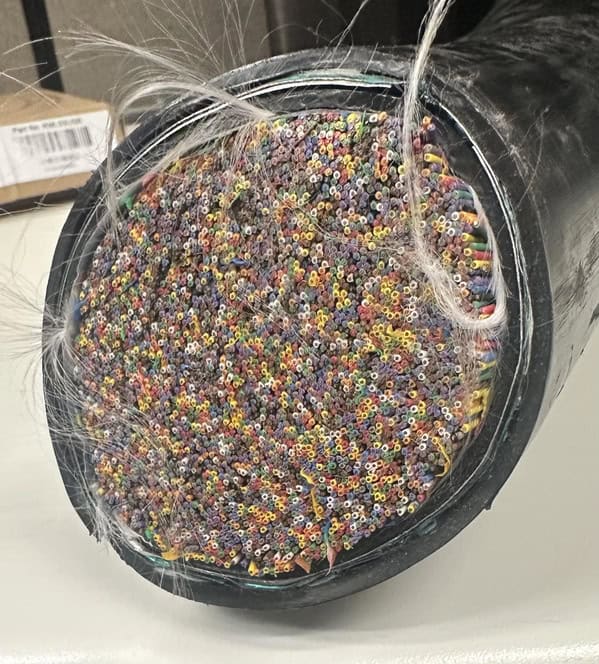
They make (made) ’em bigger than that. 4800 pair was a good size for “backbone” cable back yonder. Appears to be a direct burial/conduit run/underground type. Packed with jelly with the double armored metal jacket. Pain in the ass and nasty as all hell to work with. At least it was “pic” (plastic insulated conductor) vs a “pulp” (paper insulated) thus making it a little easier to splice by color code and “cable count”. You haven’t had fun until you’ve had to splice a “pulp” (semi non color coded) cable to a “pic” cable in 100+ heat 96% humidity down in a “splice pit” (hole in the ground), covered in the jelly, dirt, gnats, sweat, and what not, trying to repair an old damaged piece that some dumbass tore to hell and gone by digging and not calling for a locate. GOOD TIMES! Very little (if any) new copper being placed today, it’s all going digital with Fiber Optic. Double edged sword may bite us on the ass when the EMP hits. The copper lines would still work for the most part from the batteries in a shielded Central Office. The Fiber Optic circuits? Nope, not so much. A number of highly critical circuits are keeping the copper lines as a redundancy for just that reason. For now.
Dad worked for Southern Bell and got to deal with the end use of those pairs at the junction boxes. It was fun seeing all the color combinations they had to deal with to designate what pair was what.
It’s all “blue-orange-green-brown-slate”.
And white, red, black, yellow, violet. And then there’s off-pic (we’re not supposed to call it by the old name any more) with gold as well.
I remember what it was called!!!! hahahaha!!!
Know a guy that used to do lawn sprinklers. Even though Miss Dig was called they made a bit of an error in the marking and he ran the trencher through one of those cables that was buried. Knocked out a lot of phones.
Isn’t it rather 1200 PAIRS, which means a pair per household, so 1200 households? It’s that way in Germany, If I am not mistaken.
That depends on what year it was. It can be up to 4,800 households because around the ’60s they were able to modulate the frequency for each household and one pair could handle multiple calls at once


They make (made) ’em bigger than that. 4800 pair was a good size for “backbone” cable back yonder. Appears to be a direct burial/conduit run/underground type. Packed with jelly with the double armored metal jacket. Pain in the ass and nasty as all hell to work with. At least it was “pic” (plastic insulated conductor) vs a “pulp” (paper insulated) thus making it a little easier to splice by color code and “cable count”. You haven’t had fun until you’ve had to splice a “pulp” (semi non color coded) cable to a “pic” cable in 100+ heat 96% humidity down in a “splice pit” (hole in the ground), covered in the jelly, dirt, gnats, sweat, and what not, trying to repair an old damaged piece that some dumbass tore to hell and gone by digging and not calling for a locate. GOOD TIMES! Very little (if any) new copper being placed today, it’s all going digital with Fiber Optic. Double edged sword may bite us on the ass when the EMP hits. The copper lines would still work for the most part from the batteries in a shielded Central Office. The Fiber Optic circuits? Nope, not so much. A number of highly critical circuits are keeping the copper lines as a redundancy for just that reason. For now.
Dad worked for Southern Bell and got to deal with the end use of those pairs at the junction boxes. It was fun seeing all the color combinations they had to deal with to designate what pair was what.
It’s all “blue-orange-green-brown-slate”.
And white, red, black, yellow, violet. And then there’s off-pic (we’re not supposed to call it by the old name any more) with gold as well.
I remember what it was called!!!! hahahaha!!!
Know a guy that used to do lawn sprinklers. Even though Miss Dig was called they made a bit of an error in the marking and he ran the trencher through one of those cables that was buried. Knocked out a lot of phones.
Isn’t it rather 1200 PAIRS, which means a pair per household, so 1200 households? It’s that way in Germany, If I am not mistaken.
That depends on what year it was. It can be up to 4,800 households because around the ’60s they were able to modulate the frequency for each household and one pair could handle multiple calls at once