2 thoughts on “could this be related to the 6~7 trend?”
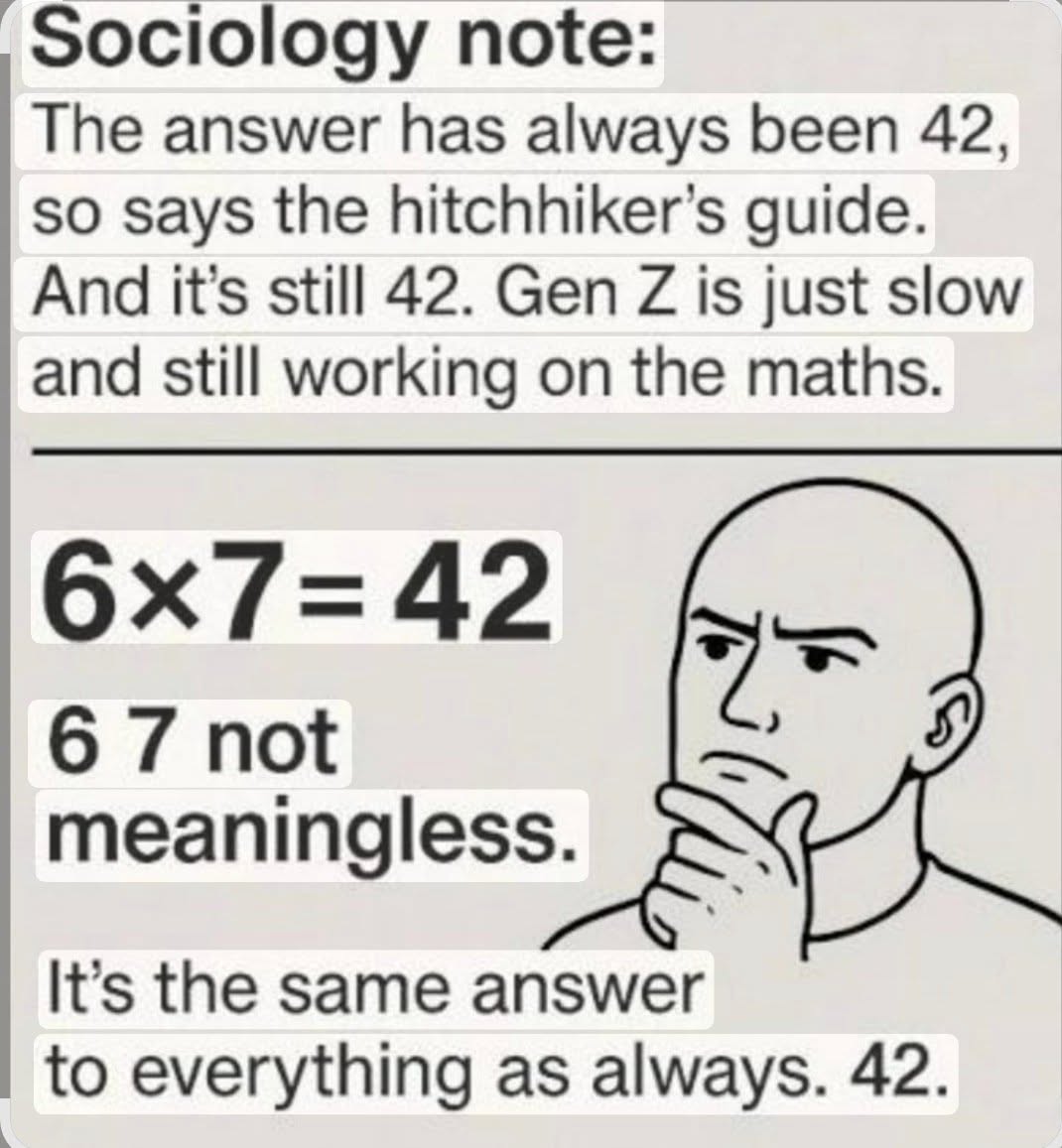
I doubt many Gen Z have even heard of Douglas Adams, let alone the first volume of his 5-volume story line (with the 5th published after his death).
“What do you get if you multiply six by nine?”
is what Arthur Dent, the main protagonist, gets when he blindly pulls letters from a home-made scrabble set on prehistoric Earth.
It follows with
““Er, that’s the lot,” said Arthur, “that’s all there were.” He sat back, nonplussed. He rooted around again in the knotted up towel but there were no more letters. “You mean that’s it?” said Ford. “That’s it.” “Six by nine. Forty-two.” “That’s it. That’s all there is.””
(The Restaurant at the End of the Universe, chapter 33)
6×9=42 actually is correct – if you count in Base 13 (4×13+2=54 in Base 10). But a bit earlier the characters realize that probably the intended Earth population was replaced by the Inhabitants of the Golgafrincham Ark B (and Arthur being a descendant of them), so that answer-question is at least … suspect

I doubt many Gen Z have even heard of Douglas Adams, let alone the first volume of his 5-volume story line (with the 5th published after his death).
“What do you get if you multiply six by nine?”
is what Arthur Dent, the main protagonist, gets when he blindly pulls letters from a home-made scrabble set on prehistoric Earth.
It follows with
““Er, that’s the lot,” said Arthur, “that’s all there were.” He sat back, nonplussed. He rooted around again in the knotted up towel but there were no more letters. “You mean that’s it?” said Ford. “That’s it.” “Six by nine. Forty-two.” “That’s it. That’s all there is.””
(The Restaurant at the End of the Universe, chapter 33)
6×9=42 actually is correct – if you count in Base 13 (4×13+2=54 in Base 10). But a bit earlier the characters realize that probably the intended Earth population was replaced by the Inhabitants of the Golgafrincham Ark B (and Arthur being a descendant of them), so that answer-question is at least … suspect